
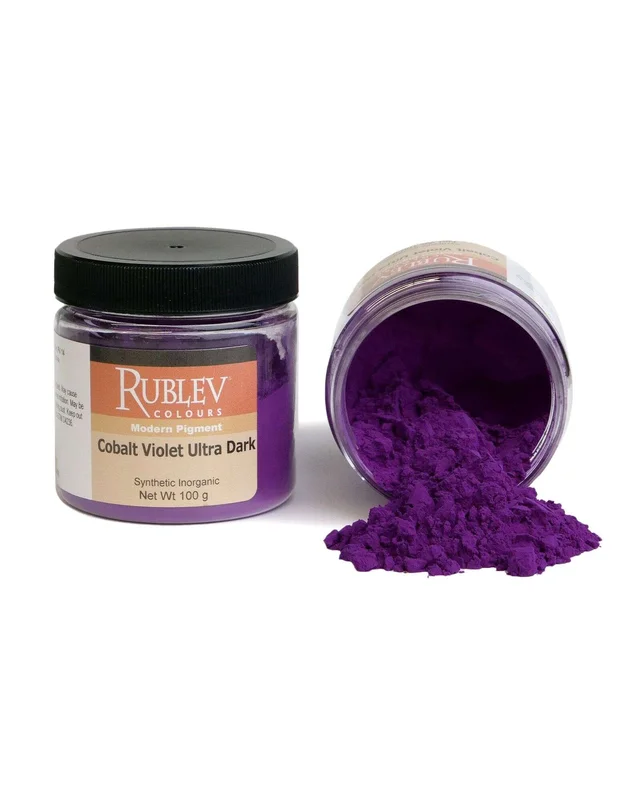
Description
Cobalt Violet (Pigment Violet 14) is a synthetic inorganic cobalt phosphate pigment producing muted violet hues ranging from pink-violet to deep blue-violet depending on preparation. It is valued for its exceptional lightfastness, chemical stability, and subtle chroma, and is traditionally used where restraint, permanence, and tonal delicacy are required rather than strong tinting power.
| Pigment Names | |||||||||
|---|---|---|---|---|---|---|---|---|---|
| Pigment Nomenclature |
|
||||||||
| Common Names | English: cobalt violet French: violet de cobalt German: Kobaltviolett Italian: viola di cobalto Russian: кобальтовый фиолетовый Spanish: violeta de cobalto |
||||||||
| Synonyms | C.I. Pigment Violet 14 Caprice Violet C.I. Pigment Violet 14 Cobalt Magenta Cobalt Phosphate Cobalt Pink Cobalt Raspberry Cobalt Red Cobalt Red Violet Cobalt Rose Cobalt Violet Cobalt Violet Brilliant, dark Cobalt Violet Dark Cobalt Violet Deep Cobalt Violet Light Cobalt Violet Pale Cobalt Violet Phosphate Cobalt Violet Pink Shade Cobalt Violet Pink Shade Light Cobalt Violet Medium Cobalt Violet Rose Cobalto Violeta Kobalt Violet Light True Cobalt Violet Pigment Violet 14 True Cobalt Violet Light Violet de Cobalt Violetto Cobalto |
Origin and History
Cobalt violet pigments were developed in the mid-nineteenth century during the expansion of cobalt-based color chemistry. The preparation of cobalt phosphate violet was first described by Salvetat in 1859 in Comptes Rendus de l’Académie des Sciences. These pigments were part of a broader group of cobalt colors, including cobalt blue and cobalt green.
Despite excellent permanence, cobalt violet saw limited historical use due to its high production cost and very low tinting strength. By the early twentieth century, it was largely superseded in artists’ paints by stronger and more economical violet pigments, including manganese violet.
Source / Manufacture
Cobalt Violet (PV14) is a synthetic inorganic pigment produced by calcination of cobalt(II) compounds with phosphate sources to form a crystalline cobalt(II) phosphate. Variations in hydration state and firing conditions account for the range of pink-violet to deep blue-violet shades historically marketed.
Permanence and Compatibility
Cobalt violet is considered highly permanent and chemically stable in all artists’ media. It is completely lightfast and resistant to alkalis and weak acids. In oil paint, lighter shades may appear slightly muted over time due to natural yellowing of drying oils rather than pigment degradation. The pigment is compatible with all common pigments and binders.
Oil Absorption and Grinding
Cobalt violet has a moderate oil absorption, typically requiring approximately 34–37 g of oil per 100 g of pigment. It grinds easily to a smooth paste in both oil and water-based binders. As with other cobalt pigments, it can enable relatively efficient oxidative drying in oil-based systems.
Toxicity
Cobalt violet is an insoluble inorganic pigment. While not acutely toxic in normal artists’ use, it contains cobalt compounds and should be handled with appropriate care. Avoid inhaling pigment dust and follow standard studio hygiene practices.
| Pigment Information | |
|---|---|
| Color: | Violet |
| Colour Index: | Pigment Violet 14 (CI 77360) |
| Chemical Name: | Cobalt(II) phosphate |
| Chemical Formula: | Co3(PO4)2 |
| ASTM Lightfastness | |
| Oil: | I |
| Watercolor: | I |
| Acrylic: | Not Listed |
| Properties | |
| Density: | ≈ 3.8 g/cm3 |
| Oil Absorption: | 34–37 g oil / 100 g pigment |
| Refractive Inde:x | nD ≈ 1.7 |
| Mohs Hardness: | 4–5 |
Reviews
There are no reviews yet.